Compiled from published reviews, official sites and our own research; assessed remotely without firsthand experience.
How many lighthouses does Maine have, and how many can you reach?
Roughly 65 historic light stations stand on the Maine coast, more than any state except Michigan. That number gets quoted constantly and it is misleading, because most of them are on ledges and islands you cannot walk to. Our corpus of Maine places holds 47 lighthouse sites with public ratings attached, and of those, fewer than twenty can be reached by car and walked up to.
So the first thing to sort out is not which lighthouse is prettiest. It is which category you are dealing with:
- Drive up and walk to the base. Roughly fifteen stations, and this is where you should spend your time.
- See it from shore, across water. Nubble, Goat Island, Curtis Island, Egg Rock. You get a good look and a good photo and you never set foot on it.
- Boat or ferry only. Seguin, Monhegan, Burnt Island, Boon Island, Little River. Some run tours; some you see from a passing deck.
The second thing to sort out is that a lighthouse tower being open to climb is rare, seasonal and often limited to a handful of dates run by a volunteer friends group. Grounds are usually open all year. Towers usually are not. Check the operator's site before building a day around going up one.
The highest-rated Maine lighthouses
Ranked by average rating with enough reviews behind it to be meaningful. Note how tightly clustered the top is, at this level the rating tells you more about parking and crowd flow than about the building.
| Lighthouse | Town | Rating | Reviews | Access |
|---|
| West Quoddy Head Lighthouse | Lubec | 4.9 | 1,488 | Drive up |
| Cape Neddick "Nubble" Lighthouse | York | 4.9 | 631 | View only |
| Portland Head Light | Cape Elizabeth | 4.8 | 16,744 | Drive up |
| Pemaquid Point Lighthouse | Bristol | 4.8 | 3,243 | Drive up |
| Owls Head Lighthouse | Owls Head | 4.8 | 1,726 | Short walk |
| Marshall Point Lighthouse & Museum | St. George | 4.8 | 1,458 | Drive up |
| Rockland Breakwater Lighthouse | Rockland | 4.8 | 1,318 | Walk the jetty |
| Spring Point Ledge Lighthouse | South Portland | 4.8 | 747 | Walk the breakwater |
| Bug Light Park | South Portland | 4.7 | 2,518 | Drive up |
| Two Lights State Park | Cape Elizabeth | 4.7 | 1,578 | Views, no tower |
| Bass Harbor Head Light Station | Tremont | 4.4 | 4,616 | Drive up |
Bass Harbor Head at 4.4 is the outlier, and it is not because the lighthouse is worse. It is the most-visited light on Mount Desert Island with one of the smallest parking lots on the coast, and half the reviews are about that.
Portland and Cape Elizabeth: the densest cluster
If you have one day, spend it here. Four stations sit within twenty minutes of each other, and one of them is the most visited lighthouse in the country.
Portland Head Light
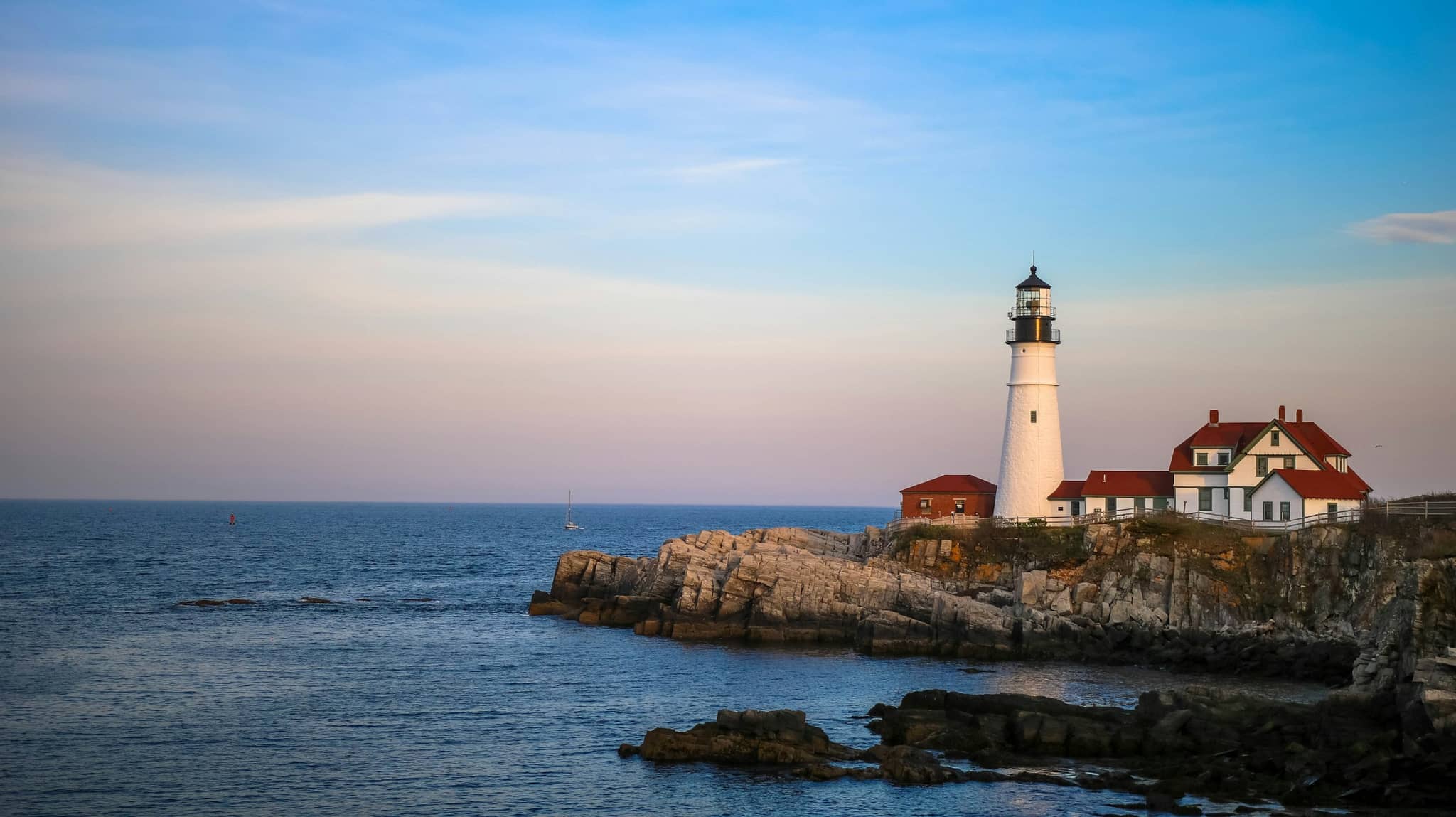
Portland Head Light is the oldest lighthouse in Maine, completed in 1791 as the first light station finished by the newly formed federal government. It rates 4.8 from 16,744 reviews (the highest review volume of any single attraction in the state outside Acadia) and it earns it. White tower, red-roofed keeper's house, black lantern room, all of it set on a shelf of dark rock with open Atlantic behind. The keeper's quarters now hold a museum; the tower itself is not open to climb.
It stands inside Fort Williams Park in Cape Elizabeth (4.8 from 3,781 reviews), which is a genuinely good park in its own right, 90 acres of headland with the concrete ruins of a coastal artillery fort scattered across it, plus a beach and space to run a dog. There are two lesser-known viewpoints on either side of the light, Head Light South Viewpoint (4.9 from 75 reviews) and Head Light North Viewpoint (4.9 from 29 reviews), and both give you the tower without the crowd standing in your frame.
The honest warning: the main lot is full from mid-morning to late afternoon in summer, and the walk from the overflow area is long enough to matter with small children. First light or the last hour before sunset are the only times it feels like the place in the photographs.
Two Lights and the Cape Elizabeth pair
Two Lights State Park (4.7 from 1,578 reviews) is named for a pair of towers built at Cape Elizabeth, and here is the catch that catches most visitors: neither tower is in the park. The east tower is an active aid to navigation on private land, and the west tower is a private house. What the park gives you is bare ledge, big surf and one of the best places on the coast to sit and watch weather come in. The nearby overlook at On The Rocks at Two Lights (4.7 from 247 reviews) is the spot for a distant photo of the east tower.
Bug Light and Spring Point Ledge
South Portland has two of the most interesting towers in Maine and almost nobody puts them on an itinerary. Bug Light Park (4.7 from 2,518 reviews) sits on a former shipyard with the Portland skyline across the water; the little cast-iron tower at the end of the spit. Bug Light Lighthouse, 4.8 from 33 reviews. Is modeled on a Greek monument in Athens, all fluted columns and scrollwork, and looks like nothing else on the coast.
Spring Point Ledge Lighthouse (4.8 from 747 reviews) is a spark-plug caisson light at the end of a 900-foot granite breakwater beside Southern Maine Community College. You walk out over the rocks to it. The breakwater is uneven and gets slick, and it is a bad idea in a swell. Our roundup of lighthouses near Portland works out the driving order for a single day.
The southern coast: York, Ogunquit and Kennebunkport
Cape Neddick Lighthouse, universally called the Nubble, is the most photogenic lighthouse in Maine and rates 4.9 from 631 reviews. It stands on its own tiny island a hundred yards off the point, with a keeper's house, a boathouse and a covered walkway, and you view it from Sohier Park (4.8 from 1,321 reviews) across a narrow, violent channel. There is no public access to the island (none, ever) and that is part of why it photographs so well: nothing modern in the frame. Sohier Park has a small lot, a snack stand and a gift shop, and it fills fast on clear evenings.
Just north in Kennebunkport, Goat Island Lighthouse (4.4 from 110 reviews) marks the entrance to Cape Porpoise harbor. You can see it clearly from the pier at Cape Porpoise and get closer on a local boat trip. Its 4.4 reflects the distance more than the station.
One to be honest about: Lobster Point Lighthouse in Ogunquit (4.6 from 547 reviews) is on the Marginal Way clifftop path and is a small stone marker rather than a working light station. The walk is excellent. Do not plan a lighthouse day around it.
The state's tallest tower is out here too. Boon Island Light (4.6 from 40 reviews) rises from a bare rock about six miles off York, and short of a chartered boat you will only glimpse it from the beach on a clear day.
The Midcoast: Rockland, Owls Head and the peninsulas
Denser and better than any stretch outside Portland, and the towers here are more likely to be open. Rockland alone has the breakwater light, a lighthouse museum and a working harbor full of schooners.
When a Midcoast outing brings you to the Boothbay peninsula, Southport’s beach, short woodland trail and inn comparison can give the shore visit a place in a longer stay. Hendricks Head’s public beach and nearby land-trust trail are distinct from the island’s lodging properties.
Rockland Breakwater Lighthouse
Rated 4.8 from 1,318 reviews, and the appeal is the approach as much as the building: a granite breakwater running most of a mile straight out into Rockland Harbor, made of massive irregular blocks with visible gaps. It takes twenty to thirty minutes each way, the surface is ankle-turning, there is no shade and no railing, and in an onshore blow the spray comes over. Do not attempt it in the dark. Parking is off Samoset Road. The keeper's house and tower open on limited days run by a volunteer group.
Owls Head Lighthouse
Owls Head (4.8 from 1,726 reviews) is the best short lighthouse walk in Maine. A path through spruce leads to a wooden stairway up the headland, and the tower (squat, and perched high enough on the cliff that it hardly needs height) looks straight down West Penobscot Bay. Sunrise here is exceptional and the lot is usually empty at that hour. The surrounding state park adds picnic ground and shoreline.
Marshall Point and Pemaquid
Marshall Point Lighthouse & Museum in Port Clyde (4.8 from 1,458 reviews) is the one with the long wooden ramp out to a small white tower, familiar to anyone who has seen the running scene in Forrest Gump. The keeper's house holds a small local museum, and the village of Port Clyde beyond it is where the Monhegan mailboat leaves from.
Pemaquid Point Lighthouse in Bristol (4.8 from 3,243 reviews) is the one to prioritize if you visit exactly one lighthouse outside Portland. The tower is fine; the rock is extraordinary. Pemaquid Point is a great tilted slab of metamorphic ledge, folded and striped in gray and white bands that run down into the surf like the grain of a board. It is the geology that puts this station on the Maine state quarter. The Fisherman Museum (4.7 from 402 reviews) occupies the keeper's house, and the tower is one of the few in Maine that opens for climbing on a regular seasonal schedule.
Camden has Curtis Island Lighthouse (4.4 from 38 reviews) at its harbor mouth, best seen from Curtis Lighthouse Overlook (4.7 from 196 reviews) on Bay View Street or from the deck of a windjammer heading out. The Rockland lighthouse guide covers this cluster in detail, including which towers open and when.
If Monhegan's lighthouse is the next stop, allow a full island outing for the ferry, village and selected walk. The Monhegan Island guide explains the ferry choices and how much time the return sailing leaves for the village, museum and trails.
The Kennebec River lights
Four small stations guard the river between Bath and the sea, and they are the most overlooked group in Maine. Doubling Point and Squirrel Point (4.5 from 156 reviews) sit on Arrowsic Island; Squirrel Point takes a short, easy walk through the woods to reach and you will likely have it to yourself. Perkins Island and Pond Island are boat views. Out at the river mouth, Seguin Island Light Station (5 from 38 reviews) stands higher above the water than any other light in Maine and houses the state's only first-order Fresnel lens. A wall of glass prisms taller than a person. It is a boat trip and a steep climb from the landing, and it is the best day a lighthouse enthusiast can have in this state.
Acadia and Downeast
Bass Harbor Head Light Station (4.4 from 4,616 reviews) is the only lighthouse on Mount Desert Island and the standard sunset stop for everyone staying in Bar Harbor. The tower and house sit on a cliff edge, and the classic photograph is taken from a rock scramble below, reached by a short set of stairs. The station is Coast Guard property and the tower is closed; the parking lot is tiny relative to demand and the National Park Service has been reworking access, so arrive well before golden hour or plan on walking in from a distance.
Egg Rock Lighthouse (4.7 from 133 reviews) sits out in Frenchman Bay and is a reliable sight on whale and puffin boats out of Bar Harbor. Winter Harbor Light (4.9 from 29 reviews) is visible from the Schoodic Loop Road on the mainland side, and Baker Island Lighthouse (4.2 from 16 reviews) requires a park boat trip to the Cranberry Isles.
Keep driving east and the payoff grows. West Quoddy Head Lighthouse in Lubec (4.9 from 1,488 reviews) is the highest-rated lighthouse in Maine on the numbers, and it is the red-and-white candy-striped tower on the easternmost point of the United States. The keeper's house is a visitor center, the surrounding Quoddy Head State Park (4.9 from 1,387 reviews) has a bog boardwalk and a cliff trail with whale sightings offshore in late summer, and the tides here run more than fifteen feet. It is five hours from Portland. Go anyway, and give it two days.
Further along the Bold Coast, Little River Lighthouse in Cutler (5 from 23 reviews) sits on an island at the harbor mouth and can be visited (and even stayed in) through the nonprofit that restored it.
Island lights and how to see them
Some of the best stations in Maine are only reachable by water, and there are three ways to do it.
- Scheduled ferries. Monhegan Lighthouse (4.8 from 45 reviews) sits on the island's high ground with a museum in the keeper's house and an art gallery beside it. The mailboat runs from Port Clyde, Boothbay Harbor and New Harbor. Grindle Point Sailors' Museum and Lighthouse (4.6 from 52 reviews) is a short state-ferry hop to Islesboro from Lincolnville. Burnt Coat Harbor Lighthouse on Swans Island (4.8 from 84 reviews) is a ferry from Bass Harbor.
- Lighthouse cruises. Operators out of Portland, Boothbay Harbor, Rockland, Kennebunkport and Bar Harbor run trips built around passing several stations. This is the efficient way to tick off Ram Island Ledge, Wood Island, Egg Rock and Goat Island, which you cannot otherwise get near.
- Tour landings. Burnt Island Light (4.6 from 91 reviews) off Southport runs an interpretive program where costumed guides work the keeper's house; Seguin has a caretaker crew and a dock.
The Maine Lighthouse Museum in Rockland (4.5 from 325 reviews) is the rainy-day answer and holds one of the largest collections of Fresnel lenses and lighthouse artifacts in the country. Worth an hour before or after the breakwater walk.
Planning a lighthouse trip that works
Three practical rules, learned the hard way.
Do not try to chain more than three or four in a day. They are spread across 3,500 miles of tidal coastline and the roads out to the points are slow. A realistic Midcoast day is Rockland Breakwater in the morning, Owls Head mid-morning, Marshall Point at lunch, Pemaquid in the afternoon, that is already six hours of driving and walking.
Light direction decides the photograph. Portland Head, Pemaquid and Marshall Point face broadly east and south and photograph best early. Bass Harbor Head and Nubble are sunset subjects. Owls Head at sunrise is the single most underrated shot in Maine.
Tower access is the exception. Most Maine towers are closed to the public year-round. One designated day each year, run by the Coast Guard together with the lighthouse friends groups, opens a large number of stations at once. Worth planning a trip around if climbing towers is the point of the exercise. Otherwise treat any open tower as a bonus, check the operating group's site the week you go, and build your day around the grounds, which are almost always accessible.
Frequently asked questions
What is the most famous lighthouse in Maine?
Portland Head Light in Cape Elizabeth, by a wide margin. It rates 4.8 from 16,744 reviews, more than any other lighthouse in the state by a factor of three, and it is the oldest lighthouse in Maine, completed in 1791. The Nubble at York is a close second for recognition and is arguably the more photogenic of the two, but it stands on an island with no public access.
Can you go inside Maine lighthouses?
Rarely, and mostly not. The grounds at most drive-up stations are open, and several keeper's houses operate as museums: Portland Head, Marshall Point, Monhegan, Grindle Point and West Quoddy Head among them. Climbing an actual tower is uncommon: Pemaquid Point is one of the few that opens on a regular seasonal schedule, and Rockland Breakwater and Owls Head open on limited days run by volunteer groups. One designated day each year opens a large number of stations at once. Always confirm with the operating organization before you go.
Which Maine lighthouse is worth driving furthest for?
West Quoddy Head in Lubec. It carries the highest rating of any lighthouse in the state at 4.9 from 1,488 reviews, it is the only candy-striped tower in Maine, it stands on the easternmost point of the country, and the state park behind it has a bog boardwalk and a cliff walk with whales offshore in late summer. It is about five hours from Portland, so treat it as a two-day trip rather than a detour.
How many lighthouses can you see in one day in Maine?
Three or four if you want to actually look at them. In the Portland area you can manage more, because Portland Head, Bug Light, Spring Point Ledge and the Two Lights viewpoints are all within twenty minutes of each other. Five in a morning is realistic there. Anywhere else on the coast, the peninsulas run north to south and every station means driving out and back, so plan on an hour of car time between each.